


Introduction
The Nintendo 64 (N64) console holds a special place in the hearts of many gamers, known for its groundbreaking 3D graphics and iconic game library. However, what made the N64 truly unique was not just its standard controller but also the range of peripherals that expanded gameplay possibilities and added new dimensions to the gaming experience. In this blog, we will delve into the world of N64 peripherals, exploring the innovative accessories that went beyond the traditional controller.
The Rumble Pak

Adding Immersion to Gameplay One of the most memorable and widely known N64 peripherals is the Rumble Pak. Released alongside the game “Star Fox 64,” this accessory brought haptic feedback to the console. The Rumble Pak, which plugged into the N64 controller, vibrated in sync with in-game events, providing players with a physical sensation that enhanced immersion. Whether it was feeling the impact of an explosion or the rumble of a racing car, the Rumble Pak added a new level of excitement to gaming experiences. The success of the Rumble Pak led to its integration into other N64 titles, such as “The Legend of Zelda: Ocarina of Time” and “GoldenEye 007,” further enhancing the gameplay by immersing players in the virtual world.
The Expansion Pak
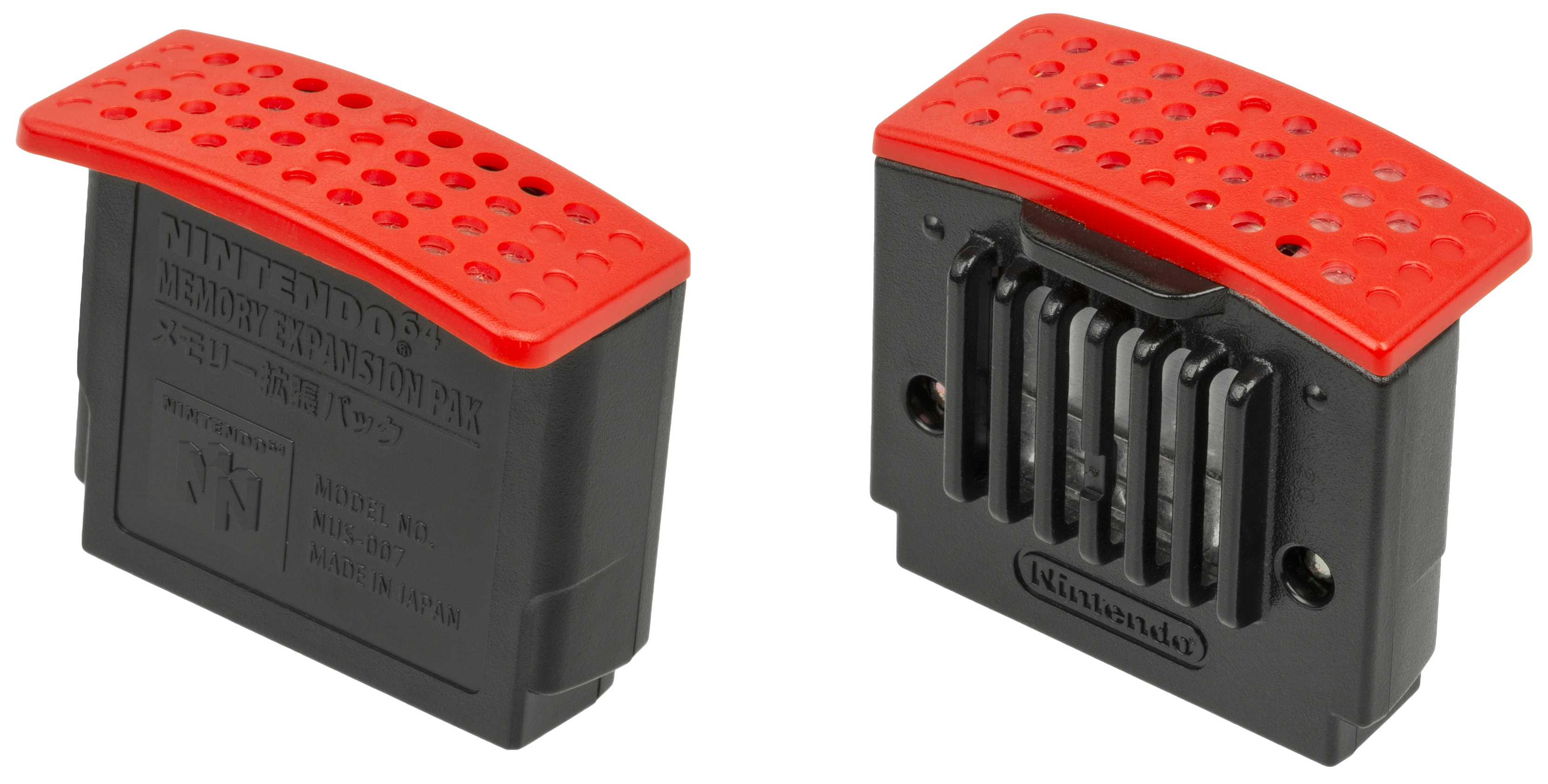
Expanding Possibilities The Expansion Pak was a game-changer for the N64. This peripheral increased the console’s RAM from 4MB to 8MB, allowing for improved graphics, larger environments, and more complex game mechanics. With the Expansion Pak, games like “The Legend of Zelda: Majora’s Mask” and “Perfect Dark” were able to deliver enhanced experiences that pushed the limits of the console’s capabilities. The Expansion Pak not only improved the visual fidelity of games but also enabled developers to create more detailed and immersive worlds. It also unlocked additional features, such as higher resolution modes and improved frame rates. The Expansion Pak was an essential accessory for gamers who wanted to experience the full potential of their N64 games.
The Transfer Pak

Bridging Handheld and Console Gaming The Transfer Pak was a peripheral designed to bridge the gap between Nintendo’s handheld Game Boy and the N64. It allowed players to transfer data between compatible Game Boy and N64 titles, opening up new possibilities for cross-platform connectivity. Games like “Pokémon Stadium” and “Mario Golf” utilized the Transfer Pak, enabling players to import characters, unlock bonuses, and enjoy a unique combination of handheld and console gaming. The Transfer Pak also allowed players to use their Game Boy as a controller, adding a new level of familiarity and convenience for those who were accustomed to the handheld’s layout. With the Transfer Pak, Nintendo aimed to create a seamless experience for players, allowing them to take their progress on the go and continue their adventures on the N64.
The Controller Pak

Expanding Storage and Unlocking Features The N64’s Controller Pak provided additional storage for game saves, allowing players to store their progress beyond the console’s internal memory. With the Controller Pak, players could take their game saves to a friend’s house or easily switch between different games without losing progress. Additionally, the Controller Pak had the ability to unlock additional features and content in certain games. For example, in “Resident Evil 2,” the Controller Pak allowed players to save their progress and unlock the Hunk and Tofu scenarios. In “Perfect Dark,” the Controller Pak was used to store customized characters and weapons configurations. The Controller Pak was an essential accessory for players who wanted to have more control over their gaming experiences, allowing them to personalize their gameplay and carry their progress wherever they went.
Third-Party Peripherals
Innovative and Quirky Additions Beyond Nintendo’s official peripherals, the N64 also saw a variety of third-party accessories that aimed to enhance gameplay. These peripherals ranged from racing wheels and light guns to dance pads and fishing rods, providing unique and sometimes eccentric gaming experiences. For racing enthusiasts, peripherals like the “N64 Racing Wheel” offered a more immersive and authentic driving experience. Light guns, such as the “Mad Catz Blaster,” brought arcade-like shooting experiences to the N64. Additionally, accessories like the “Dance Dance Revolution Mat” and the “Bass Fishing Controller” introduced unique gameplay mechanics to specific titles. Third-party peripherals not only expanded the range of gameplay experiences available on the N64 but also catered to niche interests and allowed players to explore different genres and playstyles. While the quality and compatibility of third-party peripherals varied, they added diversity to the N64 ecosystem and offered alternative ways to engage with games.
N64 Voice Recognition

An Ambitious Experiment In an ambitious attempt to incorporate voice recognition into gaming, Nintendo introduced the Voice Recognition Unit for the N64. This peripheral aimed to allow players to control games through voice commands, opening up new possibilities for interaction. While the technology was limited by the capabilities of the time, games like “Hey You, Pikachu!” showcased the potential of voice recognition in enhancing the gaming experience. Players could interact with Pikachu using voice commands, engaging in conversations and playing mini-games. The Voice Recognition Unit was an innovative concept that aimed to create a more immersive and intuitive way of playing games. While the technology was not fully realized on the N64, it laid the foundation for future advancements in voice recognition and natural language processing in gaming.
The N64DD

Expanding Horizons While not a traditional peripheral, the N64 Disk Drive (N64DD) was an expansion unit that aimed to revolutionize the console by providing expanded storage and new gameplay experiences. The N64DD offered increased storage capacity and the ability to connect to the internet, paving the way for downloadable content and online features. However, the N64DD faced numerous challenges, including a high price point, limited software support, and a delayed release. As a result, it failed to gain widespread adoption and remained a niche product in the N64 ecosystem. Nonetheless, the N64DD represented Nintendo’s ambition to push the boundaries of gaming by introducing innovative features and expanding the capabilities of the console.
The N64 Mouse

Precision and Strategy The N64 Mouse was a peripheral primarily designed for strategy and point-and-click games. It offered enhanced precision and control compared to the standard controller, allowing players to navigate menus, manipulate objects, and strategize with greater ease. Games like “Command & Conquer” and “Indiana Jones and the Infernal Machine” supported the N64 Mouse, providing a more intuitive and immersive experience for players. The N64 Mouse also allowed for smoother cursor movement, making it easier to interact with the game world. While the N64 Mouse had limited compatibility and was not as widely adopted as other peripherals, it provided a valuable alternative for players who preferred a mouse-like input for certain genres.
Arcade Sticks and Steering Wheels

Home To replicate the arcade experience, N64 users had the option to connect arcade sticks and steering wheels to their consoles. These peripherals were popular among racing and fighting game enthusiasts, offering a more immersive and authentic gameplay experience. The “Hori Mini Arcade Stick” and the “Interact V3 Racing Wheel” were notable examples that provided precise control and enhanced gameplay for titles like “Mario Kart 64” and “Super Smash Bros.” Arcade sticks allowed players to recreate the arcade experience at home, with responsive controls and authentic button layouts. Steering wheels provided a more realistic and immersive experience for racing games, making players feel like they were behind the wheel of a high-speed vehicle. These peripherals catered to players’ preferences for specific genres and allowed them to recreate the arcade atmosphere in their living rooms.
The Bio Sensor

Pioneering Biofeedback The Bio Sensor was an experimental peripheral for the N64 that aimed to monitor a player’s heart rate and provide unique gameplay experiences based on their physiological responses. While it never saw a commercial release, the Bio Sensor showcased Nintendo’s forward-thinking approach to incorporating biofeedback into gaming. The Bio Sensor consisted of a clip that attached to the player’s earlobe, measuring changes in heart rate and translating them into in-game effects. The concept behind the Bio Sensor was to create games that could dynamically adjust the gameplay experience based on the player’s emotional and physical state. While the technology was ahead of its time and faced limitations, such as accuracy and compatibility, the Bio Sensor demonstrated Nintendo’s willingness to explore new avenues for enhancing player engagement and immersion.
Conclusion
The N64 peripherals expanded the gaming experience beyond the standard controller, offering innovative ways to interact with games and pushing the boundaries of what was possible on the console. The Rumble Pak added tactile feedback, immersing players in the action. The Expansion Pak provided improved graphics and larger game worlds, elevating the visual experience. The Transfer Pak bridged the gap between handheld and console gaming, enabling cross-platform connectivity. The Controller Pak expanded storage and unlocked additional features. Third-party peripherals brought diversity and unique gameplay experiences. Although not all peripherals were equally successful or widely adopted, they showcased Nintendo’s commitment to innovation and provided players with new ways to engage with their favorite titles. Whether it was enhancing immersion, expanding storage, enabling connectivity, or exploring experimental technologies, the N64 peripherals played a significant role in shaping the gaming experiences of a generation.